
By Leocadia Bongben
Mobilizing More for Climate, MoMo4C, a five-year project implemented in the Cameroon side of the TRIDOM landscape by WWF, has concluded with more than 500 cocoa producers adopting improved agricultural practices for climate change resilience and increased harvest.
From 2020 to 2025, the initiative facilitated the creation of business cases in cocoa production, non-timber forest products (NTFP), and sustainable community forestry through multi-stakeholder involvement. Particular attention was paid to women and young people when working with local communities in Yokadouma, Mintom, and Ngoyla. The MoMo4C project worked to attract green investments for conservation and strengthen collaboration among stakeholders.
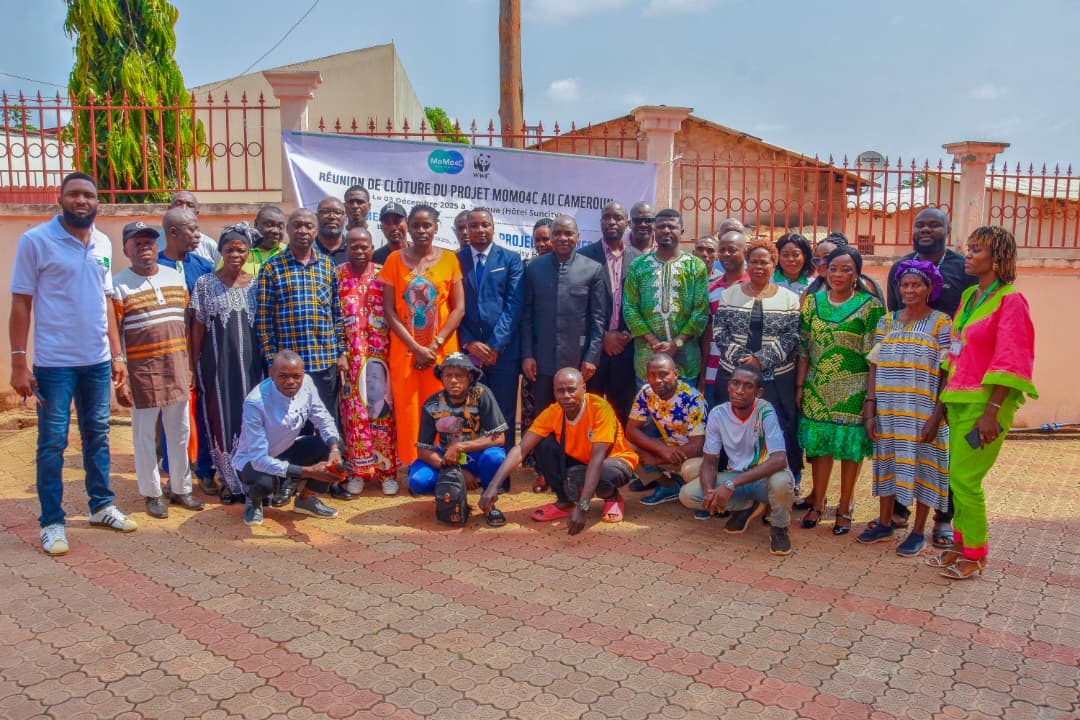
A stock-taking ceremony was held in Bertoua on December 3, marked by the presentation of the major results and lessons learnt. Patricia Djofang, Sustainable Cocoa Assistant, presented the balance sheet, revealing that more than 500 cocoa producers adopted better agricultural practices, which led to an increase in yield. Some of the good practices include using bio-pesticides and following a strict calendar to clear, prune, and remove dead cocoa pods.
Statistics indicate that cocoa production increased from 200kg to 400kg of cocoa per hectare between 2020 and 2025 in Mintom. During the same period in Yokadouma, cocoa production tripled from 300kg to 1000kg per hectare. Increased production and quality led to an increase in the revenue of the local population and indigenous people.
The project saw the inclusion of women, youths, and indigenous people, the reinforcement of women’s leadership in the transformation of non-timber forest products, and local governance. Governance was reinforced in six domains, including social and environmental protection, a complaint system, and the creation of 30,000 cocoa and fruit tree nurseries.
Stakeholders recommended, among others, the extension of the project’s activities to other areas involving more local organisations to reach more producers and beneficiaries. To ensure sustainability, it was requested that the project’s successes be disseminated to WWF intervention sites in the TRIDOM and beyond. Councils, together with the member organisations of the platforms, were urged to develop actions to sustain the successes of the MoMo4C project.
Among the lessons learnt, cooperatives have become more reliable, with support and structuring, becoming attractive and efficient in applying best agricultural practices.
Liliane Mgbadjiga of the Coopérative Or Nature outlined the benefits of the cooperative from the MoMo4C project.
Jean-Paul Nlend Nkott, Commodity Lead at WWF Cameroon, acknowledged the difficulty of implementing the initiatives in remote areas. He asserted that the producers trained by the project are the best guardians of the planet and our ecosystem. “By practising sustainable agroforestry, their efforts ensure sustainable activity without destroying the environment,” he said.
“The project has succeeded in lifting several farmers’ organizations, particularly producers, out of a situation of mere survival and improvisation, turning them to genuine economic actors with visible management capacity, recognized governance, and clear transparency… It also supported the development of exchange platforms in some of these landscapes,” Nlend Nkott said.