

By Leocadia Bongben
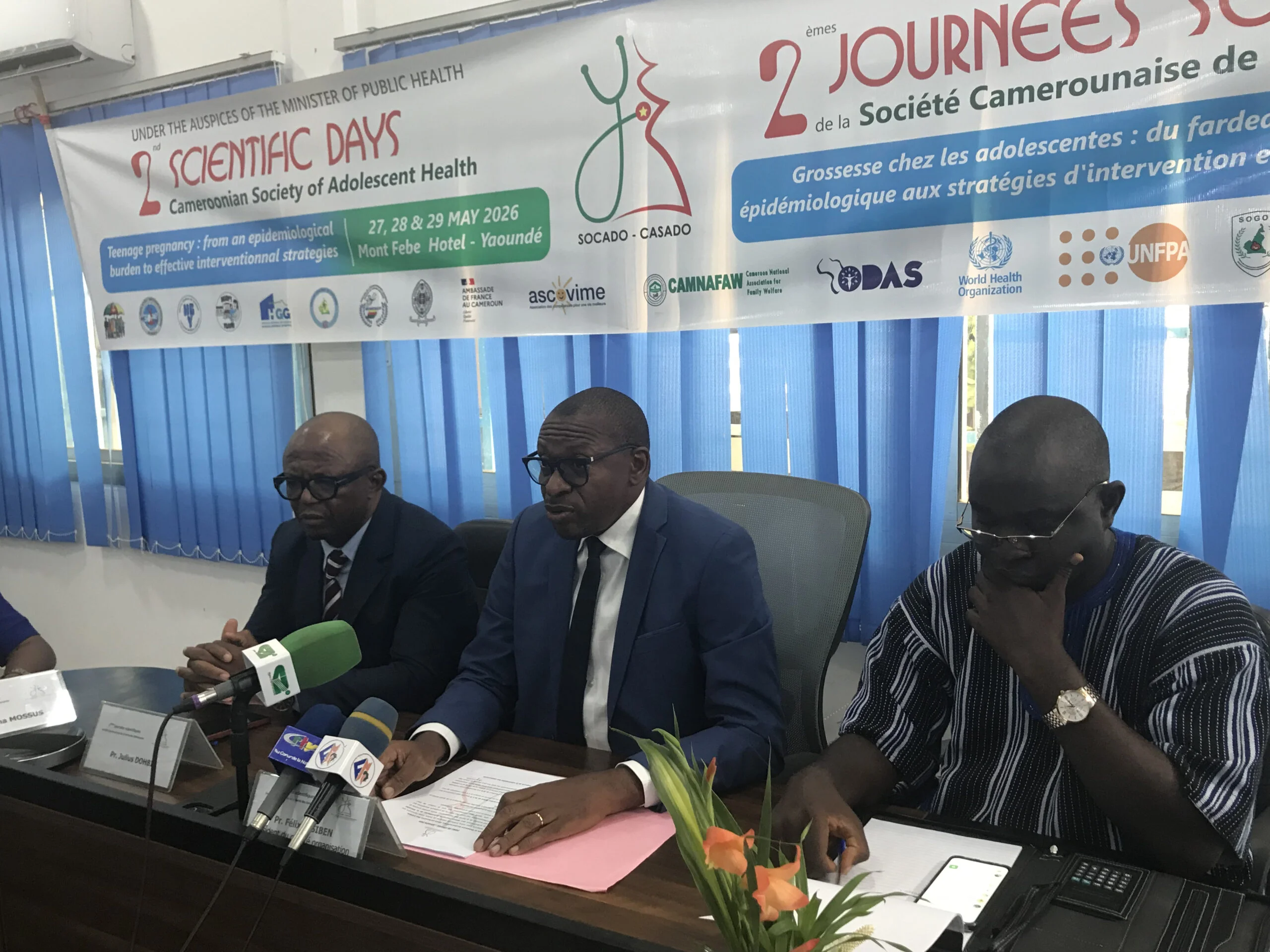
Yaoundé is set to host the second edition of Scientific Days of the Cameroonian Society of Adolescent Health, CASADO, which is billed from May 27 to 29 under the theme Teenage Pregnancy: from an epidemiological burden to effective interventional strategy, the media was told during a presser on May 22.
Teenagers make up 25% of Cameroon’s population and account for 12% of the country’s fertility rate, according to Professor Felix Essiben, CASADO President, gynaecologist, and lecturer at the University of Yaounde 1. He explained that the Far North, North, Adamawa, and East regions have high rates of teenage pregnancies as a result of early marriage and that the fertility rate is higher in rural areas (32%) than in urban areas (17%).
According to Essiben, several reasons account for early pregnancies, including barriers to information and education, such as cultural, religious, and social resistance to full sexual education; the lack of harmonised sexual and educational programmes in the school environment; and economic precarity that sometimes forces young girls into transactional relationships. Besides, teens have little negotiating power in relation to older persons, making the imposition of condoms difficult.
“The use of modern contraception is almost marginal for teenagers, reaching around 11.16%. The condom remains the mode of use, but its use is discontinuous. Unfulfilled family planning needs reach 40.8% among teenagers in a union or not, yet sexually active ones account for 16-20% in general, a phenomenon that creates vulnerability that, once the pregnancy is over, leads to many health, social, and educational consequences for the girl. The impact of early pregnancies worldwide is around triple rupture,” Essiben explained.

Early pregnancy leads to the end of education despite policies aimed at the reintegration of girls. There is a social and family struggle, which is expressed by the exclusion, stigmatisation, and rejection of teenagers, leading to a brutal end of adolescence. Unwanted pregnancies lead to health and biological, including physical, changes that affect the mental health of teenagers.
To turn the tide, Essibem maintains that community involvement, associating parents, traditional and religious leaders, can deconstruct the taboos surrounding family planning among minors and develop strategies for sensitisation and proximity, adapted to the linguistic and cultural codes of teenagers, for an effective application of prevention messages and the adaptation of care by health and reproductive services void of moral judgement for adolescents.

Early pregnancy is key to the endeavour, a burden we have to understand and fight. This is the rationale for the three days of SOCADO scientific days, which will provide an analysis and root causes of the pregnancies, tilted toward the socio-anthropological causes. The innovation is community prevention, valorising projects that work; peer communication using the codes peculiar to adolescents to deconstruct taboos; and discussing cultural and societal values to protect persons and the contraceptives to prevent unwanted pregnancies.
Adolescent Clinic at the Gyaneco Hospital
According to Professor Julius Dohbit Sama, a gynaecologist, head of the gynaecology and obstetrics unit of the Yaounde Gynaeco-Obstetric and Paediatric Hospital, and lecturer at the Faculty of Medicine, University of Yaounde, he presented the adolescent clinic created in 2013. Sama, who doubles as the vice president of CASADO, says the adolescent clinic at the Gyaneco Hospital in Yaoundé is open from 1:00 pm to 5:00 pm, providing different services, including psychological support.
At the presser were Professor Moussi Tatiana, holder of a PhD in public health, and Professor Claude Noa Ndoua, representing the scientific commission.