

By Leocadia Bongben
One sunny afternoon on June 24, in Mintom, South Region of Cameroon, about 40 of the 78 members of Scoops Expfnl, a women’s cooperative created in 2021, gathered in front of their building – a one-room cement-block house with a corrugated-iron roof. The house has three machines for processing non-timber forest products (NTFPs). It was not their usual meeting; rather, a refresher on what they had been learning over the months about farming different crops to make extra cash.

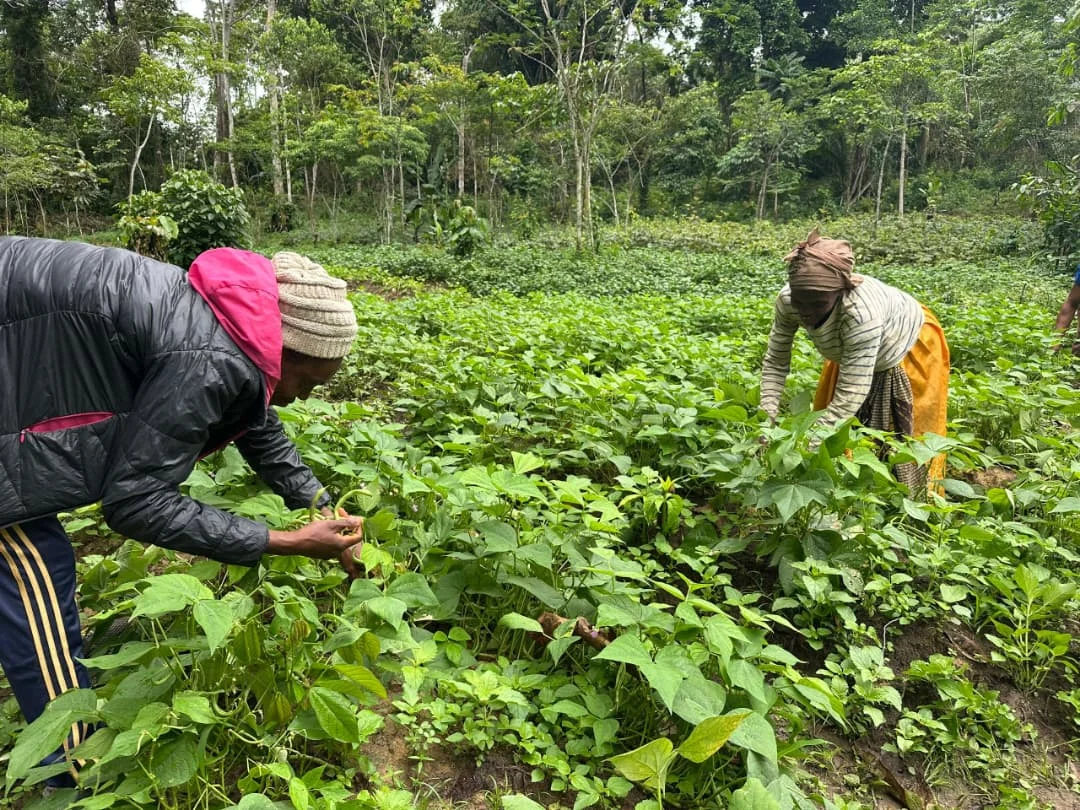
Nke Ndeme Louisette, in charge of commercialisation in the Scoops Expfnl cooperative, recalls old farming methods. “I simply dispersed okro (Abelmoschus esculentus) seeds on the farm and transplanted pepper in disorder. Now I can separate okro from pepper and other crops,” the mother of five says.
Her Majesty Mbengono Ze Pauline, 3rd class chief of Ebomane village in Mintom, who shares the same opinion about untrustworthy farming methods, adds, “I imagined okro cultivation as an extraordinary thing, difficult; meanwhile, all it takes is to learn. We just needed guidance. I have discovered that I had no reason to die of poverty. I planted okro in a portion of my farm, and the yield was good; this helped my family to spend less on buying vegetables. Now I can cultivate okro in large quantities for sale.”
The testimonies depict the change in the cooperative where women have learnt smart farming methods that bring in extra income for their families, complementing the non-timber forest products (NTFPs) off-season. These women now have new ideas gathered from market trends. They suggest that carrot farming, if associated with green beans, can fetch better sales. Scoops Expfnl women have a group farm where they have harvested and sold okro, and individual farms where they implement what they are taught.

Before now, these women farmed long-duration crops such as cassava and were worse off financially during NTFP off-seasons. Scoops Expfnl women gathered NTFPs, used as food and oil, and sold them to sustain their families since the creation of their cooperative. “We spend about two weeks in the forest to gather bush mango (Irvingia gabonensis), moabi (Baillonella toxisperma), and djansang (Ricinodendron heudelotii). In the forest, we break the bush mangos and dry them before bringing them to the village for sale. When we organise group sales, we make some money; women buy roofing sheets and kitchen utensils and send children to school,” says Ndeme.

However, the NTFP work is not without challenges. While women have to strain for other sources of income during the off-season, dwindling harvests due to seasonal changes remain a challenge. Besides, due to the long distance, trekking about 10 km in the forest, women have to endure the rain, snakes, and aggression from bandits and animals before returning to the village. While they have their products ready after their travails, another major challenge is getting buyers. “This season, elections in Gabon and Nigeria have been a drawback to our sales, given that top buyers from these countries were absent,” Her Majesty explains.
This has been the life of women in Mintom and other parts of the South region who depend on NTFPs for their livelihood before WWF came in with solutions to change their lives. “WWF has helped us a lot, showing us how to work as a group – farming the African palm weevil and mushrooms, beekeeping, and group farming of okro, pepper, and spices. In a short while, we will start harvesting pepper after we have harvested okro,” says Ndeme.
She adds, WWF wants us to become autonomous, become independent, work for ourselves, have money to send children to school from sales, and buy soap without asking men for money from our husbands.”

Mintom is close to the Ngoyla-Minton forest reserve, part of the TRIDOM (Dja–Minkebe–Odzala), a tri-national forest landscape spanning Cameroon, Gabon, and the Republic of Congo. Mbengono Ze says the forest is their wealth, a patrimony that provides for all their needs. “With deforestation, we can no longer cultivate because we do not know when it is hot or cold or how the climate changes. Thanks to the training from WWF, we are cultivating crops that do not destroy the environment, and we have a bit of money.” NGOs, such as WWF, provide Scoops Expfnl with the means and the technical know-how. They no longer depend on hunting and harvesting animals at random. Times have changed; they also cultivate in marshy areas.
Her Majesty says there is dynamism in the cooperative, as young women are developing interest in joining. As a cooperative, they stock and sell their produce, working together and attracting funding and training from NGOs. “With training, we no longer destroy the forest; the animals are multiplying. We can cultivate without burning or cutting the forest and have money,” her majesty suggested. However, a challenge lingers. “We need the push for women to own their activities and grow and look for partners. We are also asking partners to train us on the use of the machines and financial management.”
WWF is in Mintom, which is part of the Congo Basin, to support communities through a project dubbed Cameroon’s Agroforestry and Nature-Based Opportunities for People’s Empowerment, CANOPE. Estelle Assonwa, a WWF expert, says the CANOPE project focuses on helping those living around protected areas, teaching them alternatives and how to produce sustainably.
“This is because we cannot conserve without taking into consideration human wellbeing, placing man at the centre of conservation,” Assonwa says.
Forestry, governance, NTFPs collecting, and cocoa production are the four domains under question. The first approach focuses on governance and cocoa production. Everything about cocoa production, including helping cooperatives grow healthy cocoa, teaching optimal agricultural techniques to increase output and income, collecting and processing NTFPs, and looking for purchasers. According to Assonwa, “We believe that properly managed cooperatives lead to proper development of members.”

According to the expert, given that NTFPs are seasonal, WWF helps women in income-generating activities and the creation of farms, and, during the off-season, alternatives like vegetable farming come in handy. She says in the Mintom area, where men concentrate on growing cocoa, women are given special attention because they are the foundation of their households. “Women create small farms for cassava and groundnuts, and we add value to what they are already practising. It is important to have their own income,” Assonwa reiterates.