

By Leocadia Bongben
Field Legality Advisory Group (FLAG), in partnership with the World Resources Institute (WRI), is empowering law enforcement agencies with tools to fight illegal logging. This is part of the ongoing phase II of the project ‘Strengthening cross-border collaboration to combat illegal logging in the Congo Basin’, funded by the Bureau of International Narcotics and Law Enforcement Affairs (US-INL) of the US Department of State.
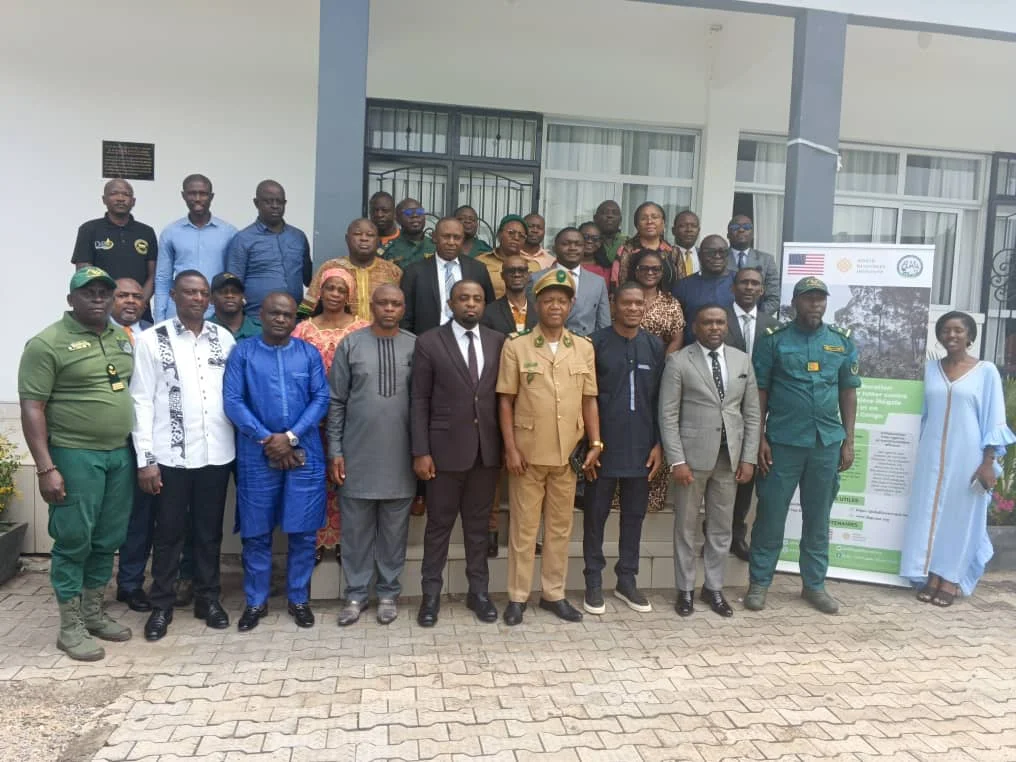
The inter-agency training workshop in the seaside town of Kribi brings together a score of officials from law enforcement agencies such as the water and forestry department, customs, the forest revenue security programme (PSRF) and magistrates serving in the Douala and Kribi ports.
According to Marc Clément Benenguegne, FLAG technical expert, the meeting’s goal is to identify and explore illegal logging using specialised tools – the Open Timber Portal, SIGIF-II, eCITES platform, Global Forest Watch, and Forest Watch – to monitor forest cover. “It is necessary to identify the targets, customs, forest authorities, magistrates who oversee forest and forestry control, and those of the tax office and provide them with tools to become proficient in wood identification,” said the FLAG expert. Acknowledging that five days is short for the training, he said it is pertinent to provide participants with the necessary tools to recognise wood, by the trunk or altered, and incorporate them into their legal work process to help them make decisions during inspections.
The meeting provided an avenue for discussion on the recognition of inquiry, the penalties, and all the improvements made to the 2024 forest law and, in the process, for becoming proficient in criminal investigation methods related to the forest law.
For his part, Duclaire Mbouna, World Resources Institute (WRI) Cameroon coordinator, revealed that the WRI supports leaders in sustainable development and has obtained funding to support Cameroonian administrations in the fight against illicit logging. He said WRI created the tool, Global Forest Watch – a platform to track forest cover – as one of the instruments for territorial management. The country-specific tool – the Forest Atlas – through which WRI helps the Ministry of Forestry map out forest titles, updates and shares information with stakeholders.
The Open Timber Portal, he explained, orients towards a conformist wood trade with the international market. The information on this platform comes from private institutions, administrations, and forest observers, such as civil society organisations, to help the private sector position itself in the international market, especially when legal.
To Mbouna, it was important to invite other actors to the training on finance and taxation in relation to species exploited and justice that treats cases related to forest exploitation, and to judge the cases, they should know where to get the right information through the online platforms and administrations. Most importantly, bring synergy among the administrations in the forestry and wood sector.
Speaking on the occasion, one of the participants said, “As customs officers, we came with limited information and grey areas in the area of wood control, especially identification of species and documentation with respect to CITES, and we have our capacities beefed up. We can now share information in real time with different administrations on platforms on wood commercialisation to better control illegal wood,” said Ze Élisabeth, a customs officer.
Putting into practice what they have learnt, the participants will visit the port, particularly its wood park, as well as the forestry and traceability checkpoint forest, where they will use their phones to locate a network of deforestation and investigate what caused the deforestation and ensure the work is at the employment management checkpoint level, which is represented by the forestry and deforestation programme to allow each administration to come in contact with the legislation regarding how it can use the tools on the ground.
A coordinating platform was created between different administrations to share information in real time and support proper decision-making in the forest and wood sector.