

By Leocadia Bongben
Cameroon’s Ministry of Planning and Regional Development, MINEPAT, joined the Rainforest Alliance to urge stakeholders from both public and private organisations to look into ways to manage land more effectively and uphold sustainable agricultural production without compromising landscapes.
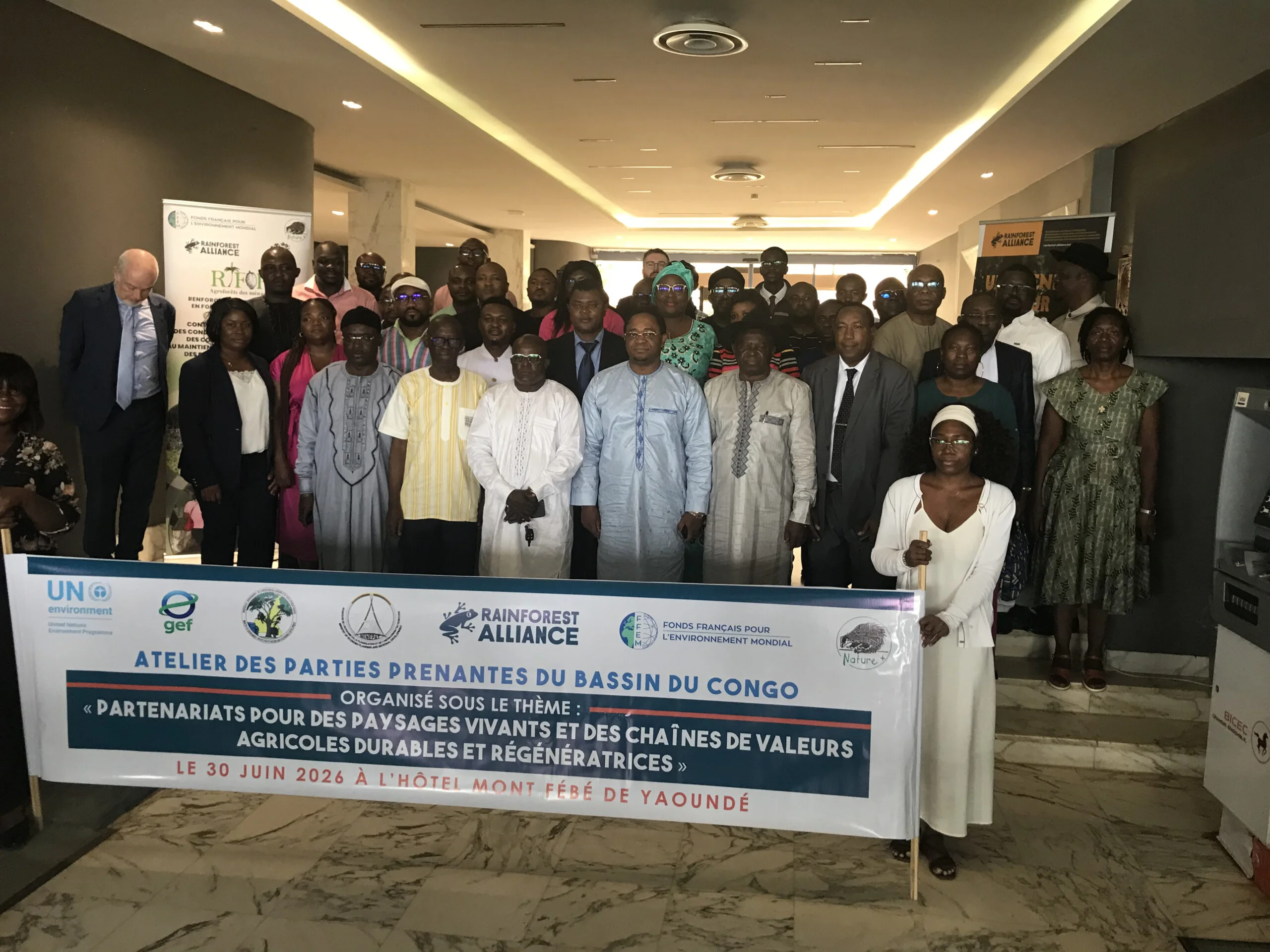
This was during the Congo Basin regional partners’ meeting organised by the Rainforest Alliance at the Mont Febe Hotel on June 30, under the theme ‘Partnership for Living Landscapes: Sustainable and Regenerative Agricultural Value Chain’.
On the occasion, stakeholders concurred that industrialisation, the changing agricultural value chain, managing forests sustainably, and transforming the environment into a veritable growth and sustainable development for the region’s benefit can all coexist.
Romeao Noulie Delisse, in charge of the studies and schemes at MINEPAT, presenting the case of land-use management in Cameroon, stated that the challenges facing land use management include deforestation and forest degradation, uncontrolled agricultural extension, illegal exploitation of our resources, climate change, conflicts of use and occupation of space, strong demographic pressure, and the growing population, which will inevitably have an impact on reserves and parks because people need to find food.
He maintained that Cameroon has developed tools such as a zoning plan to organise the functional occupation of the national space, to identify and distribute territorial vocations, and to implement the national development and sustainable development scheme of the territory. “The development of the territory can be a tool of regulation, time and space regulation; an instrument of coherence of our public policies; a lever of sustainable and balanced development; and a mechanism of prevention of different conflicts of use and occupation of resources,” he stated. To him, the national and local tools that Cameroon has developed show that natural resources must be valued sustainably in a coherent framework of organisation of space. The main orientations concerning the landscape revolve around the development of agricultural lines and agropoles to improve income and help the rural populations, Delisse said.
He maintained that the forests of the Congo Basin constitute a strategic capital for Africa and the world, and tools of land management within Cameroon provide a coherent framework that allows the integration of economic development, conservation of natural resources, climate resilience, and territorial inclusion.
Guy Debok Nghetining, Director of Land Management and Valuation of Frontal Areas at MINEPAT, representing the minister, underscored the importance of environmental preservation while promoting economic growth and improving environmental well-being. He urged stakeholders, “To go beyond forestry exploitation and the effects of climate change to explore ways to help the population adopt sustainable agricultural production and improve their living conditions without compromising the landscape or destroying nature. Improving the living conditions of the population and strengthening agricultural productivity to avoid deteriorating the environment is critical and in line with the theme: ‘Partnership for Living Landscapes: Sustainable and Regenerative Agricultural Value Chain.’
According to him, land development is essential for uniting stakeholders around common issues related to forestry, mining, water, livestock, and agriculture. He claims that to determine various uses for landscapes, land development brings these stakeholders together. He used the middle plain as an example, saying that it is primarily ideal for agriculture and that more farmers and producers should be placed there to relieve strain on the forestry areas, where different kinds of cultures may flourish. For instance, non-linear forestry products can be created in forests and provide resources for nearby people. “Land development, in fact, allows all these stakeholders to get together and discuss and make proposals on where we are doing what to limit conflicts related to the use of land.”
Adopting sustainable and regenerative methods is the key to balancing development and environmental preservation, according to William Mala, acting country director of Rainforest Alliance. Because all of these processes occur in the same area, adopting sustainable and regenerative farming techniques is also linked to sustainable forest management practices. From this perspective, discussing land management is crucial.

He claims that everyone wants sustainability by 2030 and that the debate over land management arises from the reality that some industries are growing at a particular rate. “This is crucial because, after six years of planning, we want to know how far we’ve come, how we can go forward, what obstacles we face, and how we can collaborate to accomplish the goals despite the difficulty of raising financing,” Mala said. Increasing investment requires collaboration between producers, funders, and the public and private sectors. One important way to address some of the problems is to incorporate more creative financing methods,” he stressed.
The Rainforest Alliance has been leading the way in sustainable development for almost 40 years, and by 2024, it will have covered more than 25 million hectares; certified crops are grown in compliance with strict sustainability guidelines, with environmental, social, and economic sustainability all covered in detail by these standards. Operating in 62 countries, Rainforest Alliance supports more sustainable land management techniques while cultivating prosperous rural economies, which is the most extensively tested method for maintaining tropical forests and recovering biodiversity.

The Rainforest Alliance has been working in the Congo Basin (Cameroon, Gabon, Congo and the Democratic Republic of the Congo) since 2006, contributing to forest conservation, sustainable landscape management and the development of supply chains for forest and agricultural products in line with international standards for sustainable management. We reach nearly 75,000 producers and rural communities through our landscape management and certification programmes in the Congo Basin.
The stakeholder meeting was an avenue to present the Rainforest Alliance certification programme, focusing on version 1.4 of the Rainforest Alliance Sustainable Agriculture Standard and the new Rainforest Alliance Regenerative Agriculture Standard, which promote soil health and fertility, biodiversity and climate resilience, with a view to securing a better future for people and nature; and key tools developed by the Rainforest Alliance and its partners relating to land-use planning (such as the Guide for designating certain areas as Priority Planning Zones in Cameroon), living landscapes and sustainable and regenerative agricultural value chains.