

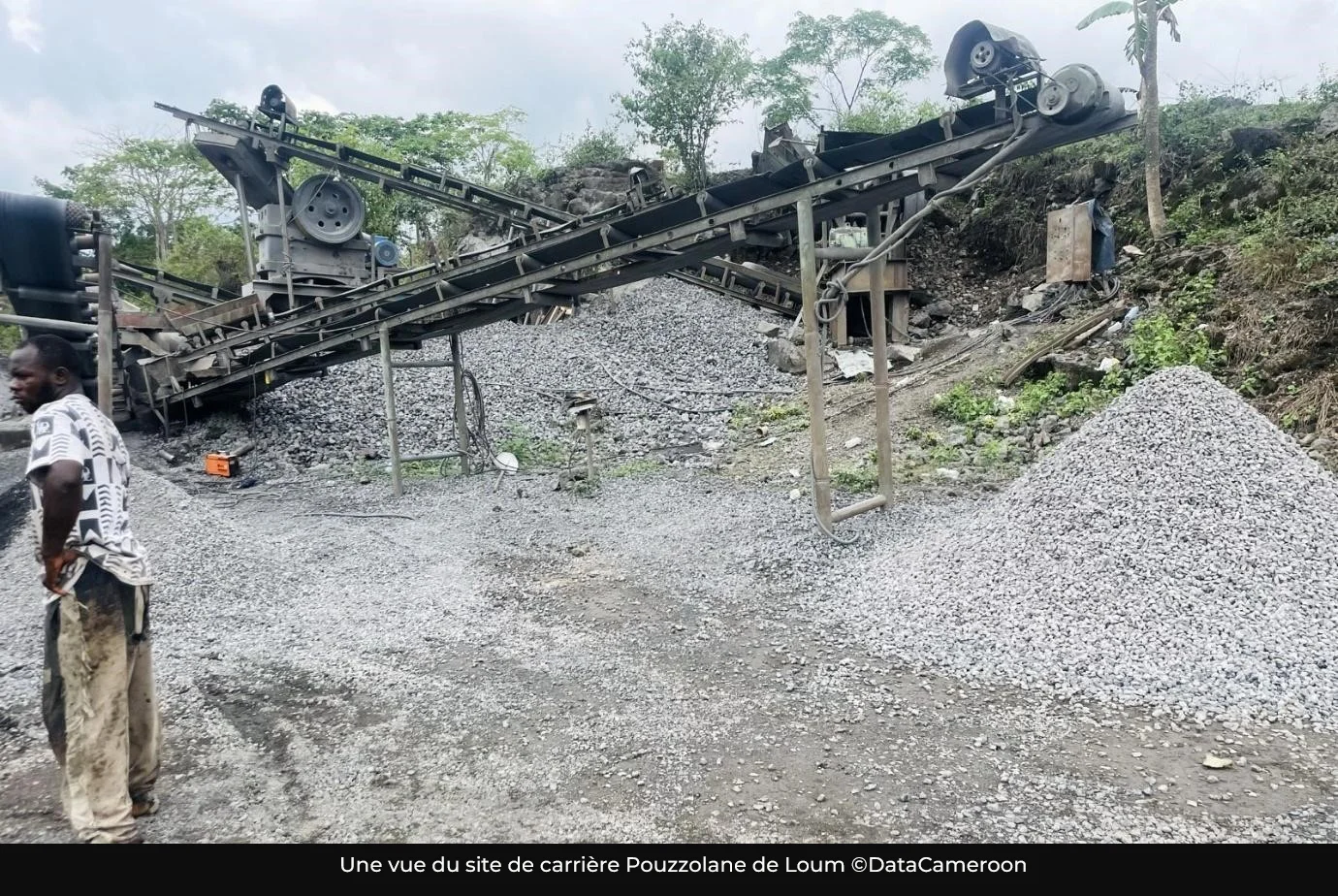
Presented as an engine of local development by the SND30, the quarrying sector generates approximately 400 million CFA francs annually for the public treasury and supplies the country’s major construction projects. However, behind this rapidly expanding activity, residents denounce a system dominated by public and private interests, opaque commitments, and almost invisible benefits on the ground, all in violation of the mining code.
It is 6:00 AM on Thursday, March 5, 2026, in Akak I, in the commune of Soa, a small town in the Mefou-et-Afamba department of the Central Region; raised voices and an unusual commotion abruptly awaken the residents. In front of the entrance to the VASTE quarry, operated by the Chinese company China Meilan Cameroon Company SARL, which specializes in ornamental stones, groups of residents are gradually gathering in a growing commotion. Alerted, men, women, and young people converge on the site, completely blocking the main access road. Between stalled motorcycles and heated discussions, the tension rises under the watchful eyes of the company’s employees. “We demand our rights!” They must pay us since they took our land,” read the signs held by the protesters. In this locality, the village chief of Nkou-Assit, Dominique Isacar Bilongo, claims that the compensation promised since 2019 has never been paid. He also mentions land rents estimated at 10 million FCFA per year for seven years, totaling approximately 70 million FCFA, which remain unpaid. This claim is difficult to verify, especially since none of the documents consulted during this investigation clearly outline the contractual obligations.
These demands are not limited to Akak I. Generally speaking, most quarry sites in Cameroon are frequently the scene of protests by local communities. The populations denounce the fact that they do not benefit from the redistribution of revenues generated from the exploitation of their resources, in accordance with the provisions of Article 135 of the 2023 Mining Code. This article stipulates that “populations living near a small-scale or industrial mine are entitled to compensation, the amount of which is deducted from the ad valorem tax (based on the value).” [Editor’s note] In Nyom, in the 1st arrondissement of Yaoundé, the chief of Edimi, Fabien Raphaël Ngolo, echoes the complaints of the local population, who are demanding not only what the quarries in their area actually produce but also what they pay to decentralized local authorities, particularly the local council.
Opacity of contracts and environmental impacts
The same concerns are echoed in the commune of Mbankomo, specifically in Eloumden, where criticism focuses primarily on access to the specifications document meant to outline the operators’ obligations. Paulin Théophile Onana, a village elder, asserts that the local population is unaware of its contents and has no access to it. Residents, who denounce their exclusion from any profits generated by their quarry, describe an environment profoundly disrupted by the extractive activity, with dozens of trucks crossing the area daily, raising thick clouds of dust on unpaved roads. Faced with this near-constant dust cloud, they say they are regularly forced to block traffic to limit the nuisance and protect themselves. According to counts conducted on-site on Saturday, February 22, 2026, from 8:00 a.m. to 4:00 p.m., we recorded at least 84 trucks transporting products such as gravel and quarry stones.
These living conditions further fuel criticism of the local management of these quarries. His Majesty Léopold Zibi, chief of the village of Eloumden I, in turn denounces the failure of the operating companies to honor their commitments, notably Arab Contractors Cameroon Sarl for the past 20 years, Huazing Sarl for approximately two years, and Carrières Modernes for about ten years. None of the specifications are being respected. The chief specifically mentions the lack of development of the boreholes and road sections stipulated in the specifications. He is accused by his elder, Paulin Théophile Onana, of being the sole possessor of this document, the contents of which remain inaccessible to both the local population and journalists, despite repeated promises to make it available. When questioned about this, His Majesty Zibi acknowledged possessing a copy of the specifications, inherited from his father, the former village chief. However, when we tried to show it to him, he claimed he couldn’t find it.
Between occasional help and persistent frustrations
Feeling they had waited long enough, the village chiefs of Eloumden I and II, Nkoul Oman, Bibong-Bidoum, and Mhadouma in the Mbankomo council sent a letter on December 11, 2025, to the divisional officer of Mbankomo announcing planned non-violent protests. These protests were ultimately suppressed by intimidation from the administrative authorities via a phone call. On February 5, 2026, at the site of Arab Contractors Cameroon Sarl, one of the companies operating quarries in the area, the managers indicated they could not receive us. However, an employee encountered that day, on condition of anonymity, stated that their company regularly distributes water tankers to the village. Nevertheless, some residents of Eloumden consider this assistance insufficient. Marie Claire Oleme, a resident of the village, raises the issue of one-off aid packages with no lasting impact. “They often deceive us with one or two kilos of meat and rice per household. The last time was in April 2025,” she says. Beyond the promised infrastructure such as roads and drinking water points, land disputes continue to fuel tensions. Léopold Zibi, chief of the village of Eloumden 1, maintains that rent for land occupied by Arab Contractors Cameroon Sarl is several months in arrears. According to him, the company should be paying approximately two million CFA francs per year for the land.
These tensions are not limited to the central region. In the West, specifically in Bamougoum, in the Mifi department, residents of Doumdi demonstrated on January 26, 2025, against the operation of a 25-hectare aggregate quarry, awarded to the Chinese company China Longteng Sarl, which has been operating on approximately 12 hectares since 2015. They accuse the company of failing to honor its commitments regarding access to water, roads, and the construction of a health center and schools. Similar complaints in the Littoral region, in Loum, in the Moungo department: Martin Essoma, a resident of Loum, claims that the exploitation of local resources has not been accompanied by any visible improvement of basic infrastructure since 2024, when the Société de transport et d’exploitation de carrières et bâtiments (SOTECB) began operating an industrial quarry of black pozzolana on the Loum KM 99 site.
Legal framework and redistribution mechanisms
The 2023 Mining Code is quite clear on this point, particularly in Article 135, paragraph 2. It stipulates that communities living near an industrial or semi-mechanized quarry are entitled to compensation financed by the quarry extraction tax. Herman Ngono, a lawyer specializing in mining law, confirms that when a quarry site is in operation, the operating company, the state, and local communities are all supposed to benefit equitably from the resources, in accordance with the provisions of the current Mining Code. He therefore believes that the occupation of community lands without payment of the stipulated compensation constitutes a flagrant violation of the rights of residents. The lawyer points out that Article 90 of the 2023 Mining Code recognizes the right of landowners and local communities to redress or compensation, particularly in cases of “deprivation of the use or possession of the land surface.”
In 2023, according to the EITI, national quarry production, as reported by the Ministry of Mines, Industry, and Technological Development (MINMIDT), reached 902,214 tons, compared to 396,479 tons in 2022, representing an increase of 128%. Independent sources suggest annual production ranges from 300,000 to 1 million tons. Consequently, based on conservative estimates, some industry observers believe the annual revenue of the quarrying sector in Cameroon is likely in the tens of billions of CFA francs. Other, more assertive sources suggest figures between 3 and 15 billion CFA francs. Using OSINT (Open Source Intelligence) and aggregating data from all sectors (artisanal and industrial quarrying), the overall figure is between 150 and 300 billion CFA francs. These figures, however, are based on economic estimates and available reports. In contrast, the revenue actually collected by the state is significantly lower. The EITI sometimes places them around 0.99%, depending on the type of materials in the state budget chapter linked to the extractive mining and quarrying heading.
According to the 2023 report of the Extractive Industries Transparency Initiative (EITI), the sector’s declared revenues amount to over 1.18 billion CFA francs. This initial indication of the financial importance of this activity is confirmed by the 2022 statistical yearbook of the Ministry of Mines, Industry, and Technological Development (MINMIDT). Between 2016 and 2021, the tax on the extraction of hard materials, particularly stone, alone generated over 1.5 billion CFA francs for public finances. The mayor of Mbankomo, Pierre Junior Fouda Fouda, also acknowledges a blockage in the redistribution mechanism. Without providing specific figures, he explains that before 2016, some taxes were directly paid to the municipalities by the mining companies. “Since 2016, we have been waiting for the state to transfer this money to us so that the 10% intended for residents can be made available to them,” he says.
Variation des répartitions et de l’affectation des prélèvements spécifiques dans le secteur minier pour les taxes à l’extraction de toutes les activités d’exploitation des substances minérales, d’après la décision Minfi du 7 avril 2025.
The quarrying sector in Cameroon comprises a mix of industrial companies, construction and public works (BTP) companies operating their own quarries, and sand and aggregate producers. These companies include, among others, Cimencam, Arab Contractors Cameroon, Dangote, and Razel.
According to the National Union of Authorized Distributors of Quarry and Related Products in Cameroon, a single quarry in the Central Region can extract an average of up to 2,000 tons of gravel per day. In some cases, “a quarry that hasn’t even been actively operating can generate up to 500 million CFA francs in revenue per month,” states Jean-Luc Bikoi, president of the Union of Authorized Transporters of Quarry and Related Products. Comparing these estimates with the current tax framework makes the mechanism for generating revenue clear. In accordance with regulations, particularly the extraction tax stipulated in the mining code, a stone quarry pays a levy of 200 CFA francs per ton produced. Thus, for an estimated daily production of 2,000 tons, the state could theoretically collect approximately 400,000 CFA francs per day.
Over a year, this amount would be approximately 124,800,000 CFA francs per quarry. However, according to a note from the Ministry of Mines, Industry, and Technological Development (MINMIDT), dated April 5, 2023, Cameroon had 1 quarry site. Applying this same taxation principle to all of these sites, the potential annual revenue for the public treasury would reach approximately 10.2 billion CFA francs. Yet, according to the latest statistical yearbook for the sector published by the National Institute of Statistics (INS), covering the period from 2015 to 2021, total revenue from duties, taxes, and royalties on mineral sub-states, collected at the decentralized level, does not reach 800 million CFA francs per year.
The contrast is all the more striking given the significant role of the extractive sector in the 2020-2030 National Development Strategy (SND30), through which the Cameroonian government presents quarries as a driver of economic growth, job creation, and improved living conditions for local communities. On the ground, however (SND30), investigation reveals a widespread lack of transparency in the management of quarry revenues. Reports from the Ministry of Mines, Industry, and Technological Development (MINMIDT) and the EITI primarily publish, sometimes incomplete, production volumes and administrative revenues, but not the sector’s total market value.
In its latest report published in December 2025, the EITI highlights that for 2023. However, mining companies within its scope were invited to report information on community consultations; no data was submitted, preventing a full assessment of compliance with legal and contractual obligations. This is even though Cameroon’s 2018 Code of Transparency and Good Governance, in Article 6, mandates a general obligation to systematically disclose contracts related to the exploitation of natural resources.
Experts interviewed believe the main problem lies in the opacity surrounding the entire system. “From a legal standpoint, there is no real mechanism compelling ministerial authorities or mayors to publicly account for the use of funds from quarries,” explains Herman Ngono, a lawyer. According to him, there is no clear obligation for quarries to disclose amounts collected, their origin, or their allocation. Samuel Nguiffo, a lawyer and founder of the Center for Environment and Development (CED), shares this analysis. “It is up to the state to ensure that companies respect the commitments they have made,” he insists.
This lack of transparency is also denounced by Alain Djawa Walidjo, technical assistant in charge of investigations at Earth Cameroon. According to him, local administrative authorities are more interested in the taxes paid to the Treasury than in the benefits intended for local communities. “The rest is managed with the utmost secrecy,” he summarizes. However, residents accuse the municipalities of indirectly profiting from quarry revenues through certain taxes levied at the exit of the extraction sites. In Mbankomo, residents mention the payment of 3,000 CFA francs to the town hall by truck drivers transporting materials from the quarries. This sum is perceived locally as a form of informal compensation related to the passage of the vehicles. The mayor, however, rejects this interpretation. According to him, it is not a payment intended for the local population but a transport tax for quarry products paid by the transporters. “The people are not entitled to this tax,” clarifies Pierre Junior Fouda Fouda, the mayor of Mbankomo.
Indeed, according to the 2023 EITI report, the tax on the transport of quarry products, stipulated in Article C108 of the General Tax Code, is payable by vehicles transporting extracted materials, ranging from 1,000 to 3,000 CFA francs per trip, depending on the truck’s capacity. However, the EITI specifies that several difficulties remain, namely “the lack of systematic tax collection in all municipalities with quarries, the sometimes informal nature of the collection process, and the limited traceability and publication of revenues.” Michel Bissou, an expert in the extractive industry, further explains that, despite decentralization provisions that transfer certain powers to local authorities, the effective management of quarry revenues remains contingent on specific implementing decrees, which are still pending.
But beyond this controversy over what local populations do or do not perceive from the financial flows generated locally, the question of the true scale of the quarrying sector at the national level remains. According to the latest EITI report, potential quarry revenues and their transfers to municipalities are not included due to a lack of access to this information. “These cases show that local governance of mining revenues remains fragile, marked by misappropriation at the municipal level, weak adherence to regulations, and insufficient communication between companies, authorities, and communities,” the EITI states.
The sector is largely dominated by major construction groups such as Razel-Bec, Sogea Satom, Dangote, Arab Contractors, and Cimencam but is also largely comprised of foreign companies, primarily Chinese, French, and Nigerian. However, Article 63(2) of the 2023 Mining Code stipulates that quarrying licenses and permits are issued only to Cameroonian nationals or companies governed by Cameroonian law. This structure fuels tensions, as local populations accuse administrative authorities of protecting operators at the expense of the communities. In Eloumden, Léopold Zibi, chief of the village of Eloumden 1, reports instances of road blockades by residents protesting the passage of trucks. “When we blocked the roads to prevent trucks from crossing Eloumden, the authorities asked us to clear the way if we knew what was best for us,” he stated. In the same vein, the report by the NGO Earth Cameroon entitled “State of play of the situation of respect for the rights of populations living near natural resource exploitation projects in Cameroon,” published in November 2024, mentions the existence of informal alliances between operators, administrative officials, and political actors.
The organization denounces practices of intimidation and pressure, a system marked by a lack of citizen oversight and information withholding to the detriment of local communities. According to Alain Djawa Walidjo, technical assistant in charge of investigations at Earth Cameroon, this situation contributes to a climate of fear surrounding quarry management. “Many people don’t dare denounce the poor governance in the quarries,” he stated. He went on to say that “the capture of benefits intended for the local population is orchestrated around certain administrative officials who are not, however, among those legally responsible for managing the quarries on the ground.” According to this researcher, several mechanisms designed to regulate the local benefits of the extractive sector remain largely ineffective in practice.
But behind the production estimates, the actual redistribution channels remain difficult to trace. To obtain precise data on the amounts actually collected, redistributed, or returned to local communities and residents, several interview requests have been sent to the Ministry of Mines, Industry, and Technological Development (MINMIDT) since January 2026. Despite repeated follow-ups, no response has been received. The same silence surrounds the interview request submitted on February 13, 2026, to the company Arab Contractors.
However, EITI requirements normally mandate the publication of revenues collected by municipalities as well as transfers made by the state. The organization’s 2018 report already emphasized this obligation. In March 2024, Cameroon was excluded from this process due to a lack of transparency, illustrating the persistent difficulties in tracing extractive revenues. “Quarry management is complicated in Cameroon. Traceability is limited, and it’s difficult to know where the money actually goes,” acknowledges Alain Djawa Walidjo.
Hyacinthe TEINTANGUE, Bongben Leocadia JISI, Arnaud Kevin NGANO
This survey was produced as part of Cohort 1 of the Data Journalism Academies: “From the Shadows to Sanctions: Investigating, Advocating, and Resisting Kleptocracy” with support from Opening Central Africa (OCA) and NED.