

By Leocadia Bongben
Cameroonian civil society organisations have called on the government to consider a tax exemption for sanitary pads.
A panel discussion at the first-ever festival, ‘My Free Menstruation’, held in Yaoundé from May 29 to 30, to mark the World Menstrual Hygiene Day, was a perfect avenue to channel the demand to the authorities.
Statistics indicate that seven out of ten girls miss school because they lack sanitary pads. At FCFA 700 per sanitary pad, this amount is out of reach for some Cameroonian families, especially in the rural areas.
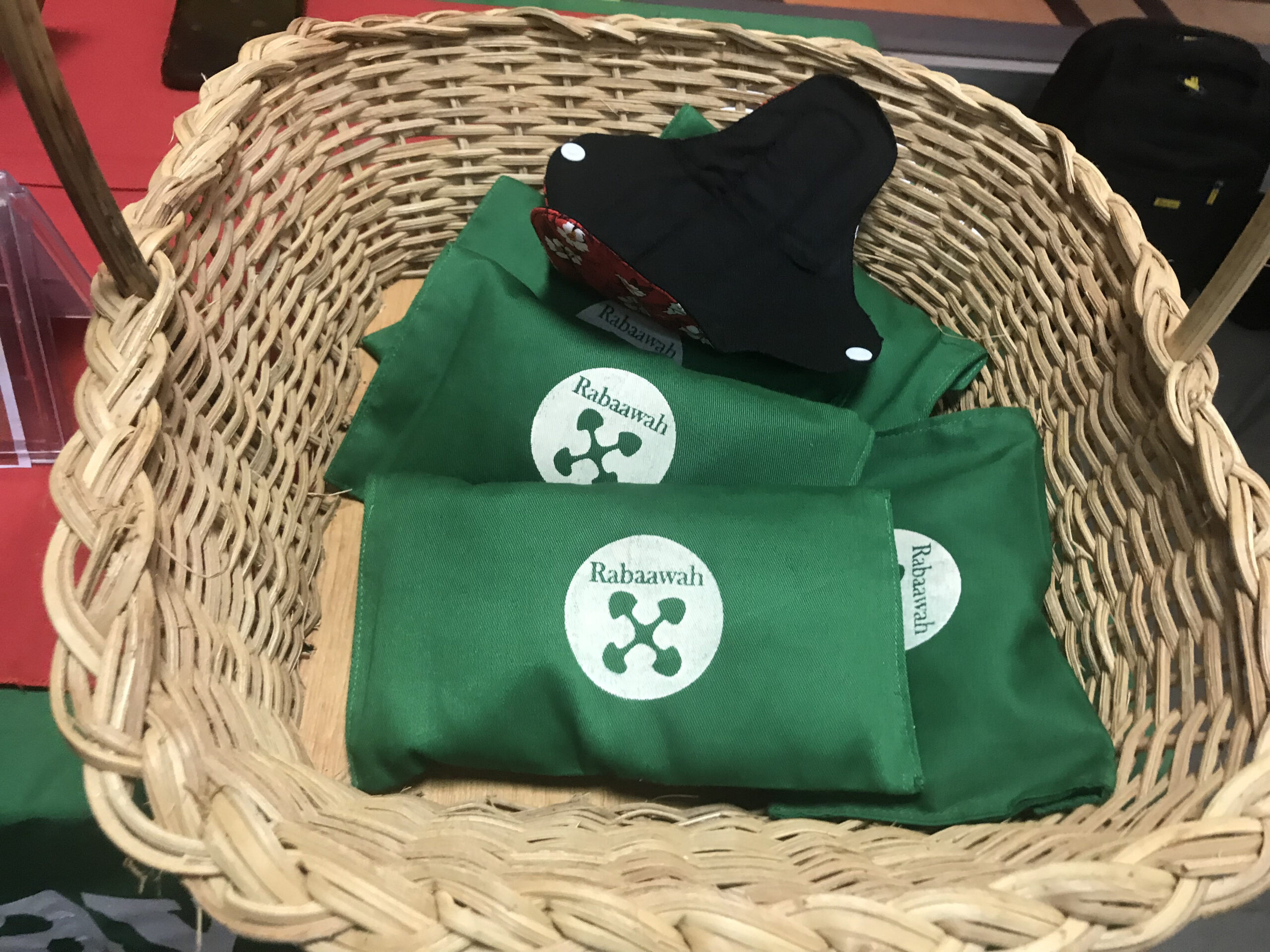
A panel consisting of Souleymane Moussa, representative of the NGO Rabawaah; Didier Florian Fotsing of the Cameroon National Association for Family and Welfare (CAMNAFAW); a representative from Royalty World; and Jacquelin Nkonlack of Médecins du Monde raised the issue of the cost of sanitary pads, even locally made reusable pads.

As a solution, NGOs like Rabawah, Médecins du Monde, and Royalty World have turned to local reusable pads, and they have been distributing them for free as part of their campaign on menstrual poverty. The reusable pads cost FCFA 3000 per packet, lasting for two to three years.
The cost of sanitary pads was one of the topics at the Free Menstruation Festival, which created a space for expression and general awareness around the question of menstruation at the level of communities and institutions in Cameroon, besides deconstructing menstruation as depicted as a taboo subject, explains Viviane Tatih, executive coordinator of the NGO Sourire de Femme, the organiser of the festival.
Societal perception of menstruation has a great influence on the condition of women and girls at the level of their well-being. The festival served to educate the public on actions around menstruation, understanding the menstrual cycle in itself, and projecting the work of local civil society organisations. To Tatih, the panel discussion served as a space for exchange to better understand how to work together to deconstruct the taboos related to menstruation.
Ina Christiane-Flore Baikol, monitoring and evaluation officer for child health activities at the Directorate of Family Health, regrets that Cameroon does not yet have a specific, standalone national policy on menstrual hygiene. However, she says in Cameroon, menstrual health is gradually being integrated into several national strategic policies related to sexual and reproductive health education; water, hygiene, and sanitation (WASH); and gender equality, among others.

“Concerning the frameworks within which menstrual hygiene is addressed, we can cite the national strategy for maternal, child, and neonatal reproductive health. We also have adolescent health and the school health policy. This includes WASH programmes in schools, as well as policies and initiatives promoting gender equality and adolescent protection,” the public health official says.
However, there are several initiatives underway at the Ministry of Health, particularly in regions across the Far North, where there is a lack of access to sanitary pads and a lack of information.
“We need to address these challenges and break the taboo surrounding menstruation. Schools need to have a designated space because a girl might get dirty, and of course, she would need water nearby so she can clean herself, as well as a toilet. And that would help her avoid infections, because without water, there is a risk of infections,” Baikol adds.
To her, the media and our awareness campaigns need to reach the most marginalised groups.
