

By Leocadia Bongben
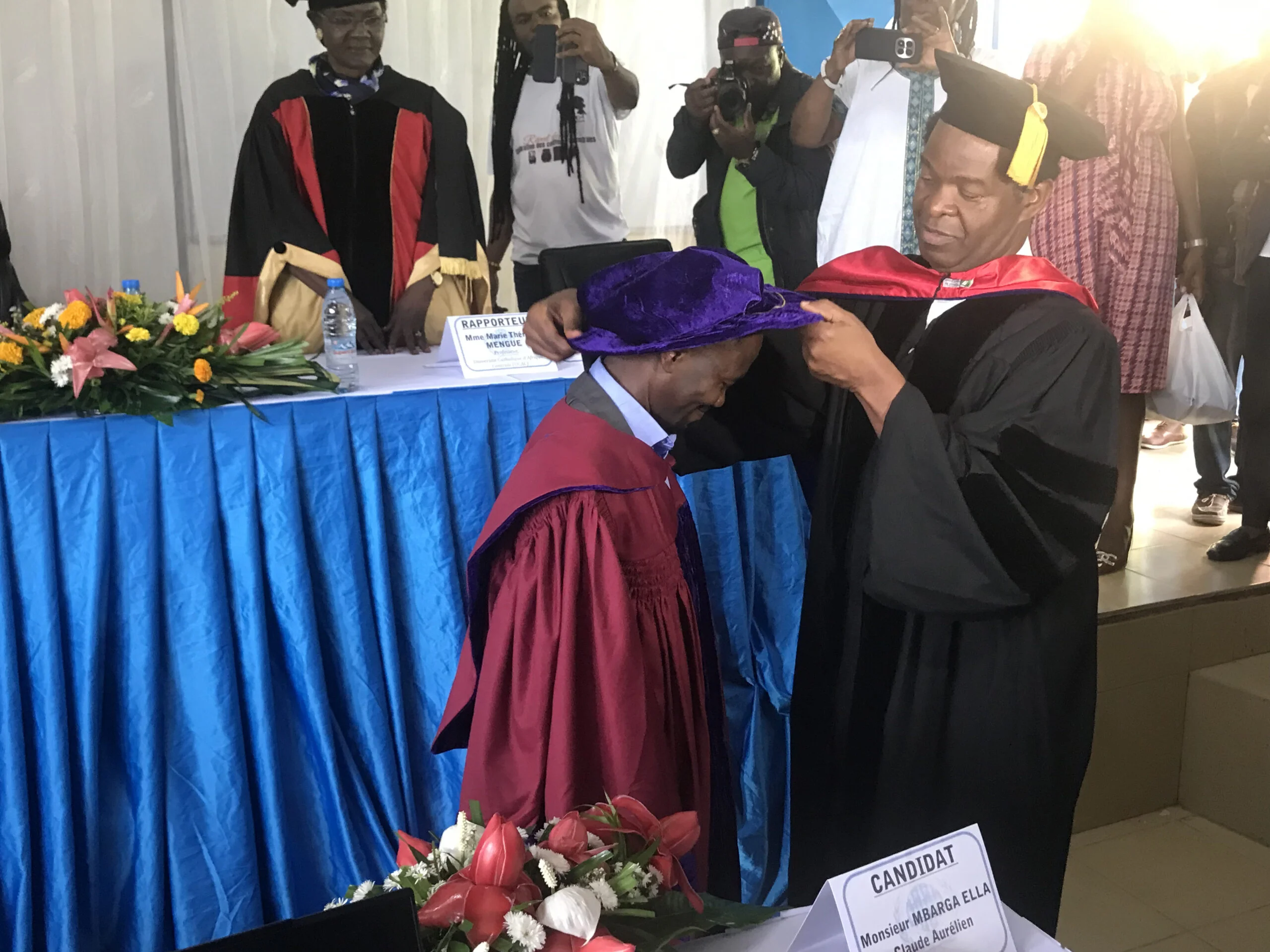
Claude Aurelien Mbarga Ella earned a doctorate from the University of Yaounde II for his PhD thesis, “Demographic dividend and socio-economic development in the African socio-cultural context: the case of Cameroon”, which indicates that the demographic dividend cannot be applied from the European to the African context. “In our African context, demographic dependence is absorbed on several scales of burden sharing borne at the level of the nuclear family, the extended family, or even in the community,” Mbarga suggests. A demographic dividend is economic growth that results from having more working-age individuals (15 to 64 years old) than young and old dependants (14 and younger and 65 and older). The change lowers the dependency ratio and increases productivity and savings.

In the European context, the demographic dividend is attained when a person has less dependence, leading to high savings. But the research reveals that in the African context, when some people have a huge dependence, they save more. In Africa and Cameroon, “The fact that dependence incites people to save more was something incredible the research revealed, raising questions about the initial theories of the demographic dividend. Culturally, this means burden sharing, but it contradicts the early theory of the demographic dividend,” according to Mbarga.
He demonstrated that the concept ‘demographic dividend’ can be applied at the local level through local planning. He took an example from the Edom village, where he made a territorial diagnosis of the population, depicting the strengths and weaknesses and how to ameliorate the development of this locality, precisely by fishing for food and rural exotics. The chosen council is semi-rural, a little bit urban and a little bit rural.
He says public policies should integrate more advanced social, cultural, and even regional analysis. “We should be able to see that if we want to make a dividend in South Cameroon, it is not the same as in the Far North or West regions, because these populations have different behaviours, and they act differently in the face of demographic dependence.”

The next step is to ensure that public policies recognise the importance of valuing culture in their implementation, particularly in the exploitation of the population for economic development. He recommends that decision-makers review the planning model based on individual dividends and integrate the different variables and, above all, see to what extent the surplus of labour can be better exploited in view of the push-up of the economic model.
Comparing Cameroon to Morocco, he says Morocco is practically in the ageing phase of its population, which means it has benefited from a labour surplus for about 30 years. He attributes this to three major elements: industrialisation, rigorous governance, and better absorption of the surplus of labour. He says Cameroon has an unexploited surplus of labour, regretting that the window of opportunity may be lost.
The president of the jury, Prof. Parfait Eloundou Enyegue, Section Head, Professor, Global Development Section, Warren Hall, Cornell University, United States, underscored the importance of the work in the grounding of the theory and global practices to the African cultural reality. From the standpoint of policy and application, “This is a decisive moment where we are trying to put into practice some of the theoretical prescriptions from dividend theory to see how we can implement them on the ground. The major originality is that it assumes that the model of occidental individualism, which is central in the theory of dividend, does not necessarily apply to African societies where there is a communitarian spirit,” Eloundou says.

Eloundou encourages Mbarge to make the work public and work with scientific journals to distil the research. He stated that his interest, coming all the way from the US, is in the topic, which is very important and needs to be rooted in Africa, and the promising candidate with whom he has worked for several years, as well as the institutional initiatives involved, including journalists to try to spread this idea of dividend and to promote scientific culture.
Professors Marie Therese Mengue from the Catholic University and Jean Robert Ewengue Mburano from the University of Yaounde II moderated the PhD thesis defence, with Sarah Giroux as jury member and Prof. Gervais Beninguisse, Director of IFORD, Yaounde II, as supervisor.
